

An essential guide to protecting your brand in China, understanding the registration process, and preparing for the 2027 Trademark Law changes.
If you manufacture products in China, sell to Chinese consumers, or are considering entering the Chinese market, there is one important question worth asking early: who owns the rights to your trademark in China?
The answer may surprise you. China’s trademark system operates primarily on a first-to-file principle. As a general rule, the first party to file a valid trademark application takes priority, even if another business has already been using the brand elsewhere.
That is why a trademark registered in Spain, Mexico, the United States, or another country is not automatically protected in mainland China.
In this guide, we explain why trademark registration matters, how the application process works, how long it may take, and what businesses should consider before entering the Chinese market. We also cover the key changes introduced by China’s revised Trademark Law, which will take effect in January 2027.
Why Is Registering Your Trademark in China So Important?
China is one of the world’s most significant markets for both manufacturing and consumer sales. However, many international businesses start working with Chinese manufacturers, distributors, or customers before securing trademark protection.
This can lead to disputes that are expensive and time-consuming to resolve.
1. A Trademark Registered Abroad Is Not Automatically Protected in China
Trademark rights are territorial. A trademark registered in Spain, Mexico, the European Union, or the United States does not automatically provide protection in mainland China.
Hong Kong and Macao also have separate trademark registration systems. A trademark registered in Hong Kong is not automatically protected in mainland China, and vice versa.
Although certain earlier rights and well-known trademarks may benefit from specific legal protections, the safest approach is generally to apply for registration in each territory where protection is needed.
2. Someone Else Could Register Your Brand First
One of the main risks is that a third party may apply to register a trademark that is identical or similar to yours before you do.
Some applications are filed in bad faith, with the intention of selling the registration to the original brand owner, benefiting from an established brand’s reputation, or preventing the business from entering China.
Although legal procedures exist to challenge bad-faith registrations, recovering a trademark can require significant time, expense, and specialist advice.
3. Your Manufacturers or Distributors Could Register Your Trademark
This risk is not limited to businesses that sell directly to Chinese consumers.
If your products are manufactured in China for export to other markets, it is also advisable to protect your trademark before engaging local suppliers.
A manufacturer, distributor, or former business partner might attempt to register your trademark without authorization, creating disputes over its use or the distribution of your products.
4. Registration Makes It Easier to Act Against Counterfeiting
A registered trademark gives its owner access to stronger enforcement mechanisms, including administrative and court proceedings against infringement and the possibility of seeking assistance from Chinese customs authorities.
Without a registration, the available legal remedies may be more limited and will depend on the circumstances.
For this reason, registering your trademark before starting operations is generally easier and less costly than trying to recover it after a dispute arises.
China’s new Trademark Law: what will change in 2027?

On June 26, 2026, China adopted a significant revision to its Trademark Law. The revised law will enter into force on January 1, 2027.
Its main objectives include combating bad-faith registrations, discouraging unjustified trademark accumulation, and strengthening intellectual property protection.
Some of the most important changes include:
- Stricter scrutiny of applications without a genuine intention to use the trademark. The revised rules target filings that lack a legitimate commercial purpose and clearly exceed normal business needs.
- A shorter opposition period. The deadline for third parties to oppose a published trademark application will be reduced from three months to two months.
- Greater oversight of unused trademarks. Registrations that remain unused for three consecutive years without a valid reason may be cancelled, including on the authorities’ own initiative.
- Stronger measures against abusive registrations. The revised law expands the tools available to address bad-faith filings and misleading trademark practices.
The existing legislation will remain in force until December 31, 2026.
These developments make it even more important to adopt a carefully planned trademark strategy that avoids both late filings and excessive applications without a legitimate business purpose.
How to Register a Trademark in China: Step by Step
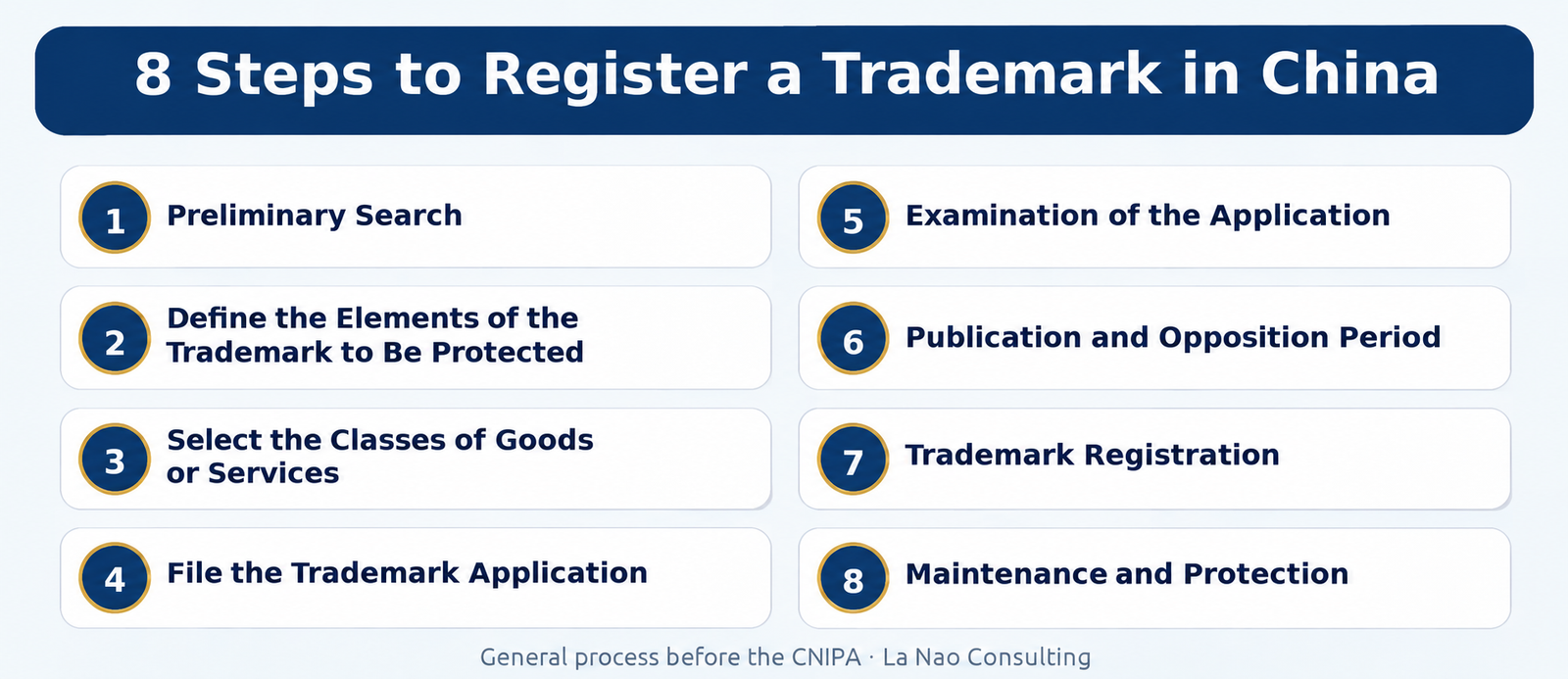
1. Conduct a Preliminary Trademark Search
Before filing an application, it is advisable to check whether identical or similar trademarks have already been registered or applied for in China.
This search can be carried out using the databases of the China National Intellectual Property Administration (CNIPA).
A proper preliminary search helps identify potential conflicts and assess registration prospects before committing to the application process.
2. Decide Which Elements of Your Brand to Protect
You should determine whether you need to register:
- Your brand name or word mark.
- Your logo.
- A combination of the name and logo.
- A Chinese-character version of your trademark.
The last point is particularly important.
International businesses often use brand names in English, Spanish, or other languages. Chinese consumers, however, may refer to a brand using a translation or a phonetic adaptation.
Registering a suitable Chinese-language version can be just as important as protecting the original name, particularly if you intend to sell products in the local market.
A Chinese brand name should be assessed for its pronunciation, meaning, commercial appeal, and availability for registration.
3. Select the Appropriate Classes of Goods and Services
Trademarks are registered for specific goods and services under the Nice Classification system.
China also uses a subclass system when examining the goods and services covered by a trademark application.
Simply choosing a broad class is therefore not enough. Businesses should carefully assess which products and services require protection and which may be considered similar or related.
A scope that is too narrow may leave important activities exposed, while applying in unnecessary classes can increase costs.
4. File the Trademark Application
There are two main routes:
National filing route
This involves submitting an application directly to the CNIPA.
As a general rule, foreign individuals and companies without a habitual residence or business establishment in China must appoint an authorized local trademark agency to handle the application.
International filing through the Madrid System
The Madrid System, administered by the World Intellectual Property Organization (WIPO), allows eligible applicants to seek trademark protection in China and other designated territories.
To use this route, the applicant must meet the Madrid System’s requirements and have a basic trademark application or registration with the relevant office of origin.
The international application is filed through that office, which forwards it to WIPO. Each designated territory then examines the request for protection under its own laws.
The best route will depend on where you need protection and on your business circumstances.
5. Examination by the Trademark Authority
Once filed, the CNIPA reviews the formal requirements and assesses whether the trademark is eligible for registration.
Common reasons for refusal include conflicts with earlier identical or similar marks covering related goods or services, or the use of descriptive, misleading, or otherwise unregistrable terms.
6. Publication and Opposition Period
If the application passes the initial examination, the trademark is published so that third parties may file an opposition.
Under the rules in force until the end of 2026, the opposition period is three months. From January 1, 2027, it will be shortened to two months.
If an opposition is filed, the process may take longer and require additional evidence or legal arguments.
7. Trademark registration
If the application successfully completes the relevant stages, the trademark is registered.
As a general indication, an uncomplicated application may take approximately 7 to 12 months, although the actual timeframe depends on the filing route, examination times, and any objections or oppositions.
A Chinese trademark registration is valid for 10 years and can be renewed for successive 10-year periods.
8. Trademark Maintenance and Protection
Registration is not the end of the process.
Businesses should monitor potentially conflicting applications, retain evidence of genuine commercial use, and keep track of renewal deadlines.
A trademark that has not been used for three consecutive years without a valid reason may become vulnerable to cancellation.
How Can La Nao Consulting Help?
At La Nao Consulting, we help international businesses protect their trademarks and develop their commercial operations in China.
Our team has experience supporting intellectual property projects and cross-border business activities. We can assist from the initial assessment of your trademark strategy through to coordinating the registration process with the appropriate authorized local agents and specialists.
Our support may include:
- An initial assessment of your trademark registration strategy.
- Coordination of trademark availability searches.
- Identifying the classes of goods and services that should be protected.
- Coordinating registration applications and monitoring their progress with local specialists.
- Guidance and coordination when potential trademark conflicts arise in China.
You can work with an international team that understands the needs of overseas businesses and can assist you in English or Spanish.
Frequently Asked Questions About Trademark Registration in China
Do I Need a Company or Office in China to Register a Trademark?
No. Foreign individuals and companies can apply for trademark registration in China without incorporating a local company or maintaining an office there.
However, foreign applicants without a habitual residence or business establishment in China will generally need to work through an authorized trademark agency.
Does My Trademark Registration in Spain, Mexico, or the United States Protect Me in China?
Generally, no.
Trademark protection is territorial. To secure registered trademark rights in mainland China, you must apply through the national route or designate China through an international registration under the Madrid System.
Some exceptions may apply to earlier rights and well-known trademarks, but businesses should not rely on those exceptions as their primary protection strategy.
How Much Does It Cost to Register a Trademark in China?
The cost depends mainly on the number of classes, the filing route, official fees, and professional service charges.
Additional searches, translations, responses to objections, or other procedures may increase the overall cost.
For this reason, we recommend reviewing the specific circumstances before preparing a quotation.
How Long Does Trademark Registration Take in China?
As a general guide, an uncomplicated application may take approximately 7 to 12 months.
Objections, oppositions, or other complications can significantly extend the process.
What Happens if Someone Has Already Registered My Trademark in China?
The options depend on the circumstances.
Depending on the case, it may be possible to oppose a pending application, seek invalidation of an existing registration, or request cancellation where the legal conditions are met.
If you believe someone has registered your trademark without authorization, it is advisable to review the registration status as soon as possible and assess your options with qualified specialists.
Should I Register a Chinese-Language Version of My Trademark?
It is not mandatory, but it is often advisable.
Chinese consumers may create their own translations or adaptations of foreign brand names. If your business has not protected a suitable Chinese version, a third party may try to register it.
Ideally, you should assess both your original trademark and a Chinese-language adaptation suited to the local market.
Do I Need to Use My Trademark in China Before Applying?
As a general rule, proof of prior use is not required when filing a trademark application.
However, applications should have a legitimate commercial basis. In addition, a registered trademark may be cancelled in certain circumstances if it is not used for three consecutive years.
The revised Trademark Law taking effect in 2027 introduces stronger controls on abusive applications and unused marks.
Why Might My Trademark Application Be Rejected?
Common reasons include:
- An identical or similar earlier trademark.
- Similarity between the goods or services covered.
- Generic or merely descriptive wording.
- Misleading or prohibited elements.
- Failure to comply with legal or formal requirements.
A preliminary search and assessment can help reduce some of these risks, although approval can never be guaranteed.
Should I Register My Trademark in Multiple Classes?
It depends on your business and expansion plans.
Registering only in your main class may lower initial costs, but could leave related goods or services unprotected.
We recommend developing a strategy covering your current activities and those you reasonably expect to pursue in the future.
When Is the Best Time to Register My Trademark in China?
Before you start manufacturing, selling, or entering into commercial negotiations in China.
It is also advisable to consider registration before showcasing products at trade fairs, sharing information with potential distributors, or launching promotional campaigns.
The sooner you assess your trademark protection, the lower the risk of a conflicting application by a third party.
Protect Your Brand Before Someone Else Does
Registering a trademark in China is an important step for any company that manufactures, sells, or plans to do business in the country.
A preliminary search, a carefully selected list of classes, and a well-planned registration strategy can help prevent future disputes.
Would you like to know whether your trademark can be registered in China?
At La Nao Consulting, we can guide you through the process, requirements, and estimated costs of protecting your brand.
Tell us which trademark you would like to register and what products or services your business offers. Our team will be happy to assist you.
This article is for general information only and was updated in November 2026. Official fees, processing times, and legal requirements may change. It does not constitute legal advice tailored to any particular circumstances. La Nao Consulting is not a law firm; when specialized legal services are required, we coordinate with duly authorized professionals as appropriate.
© 2026 La Nao Consulting. All rights reserved.